

Beer Boy
How It All Began

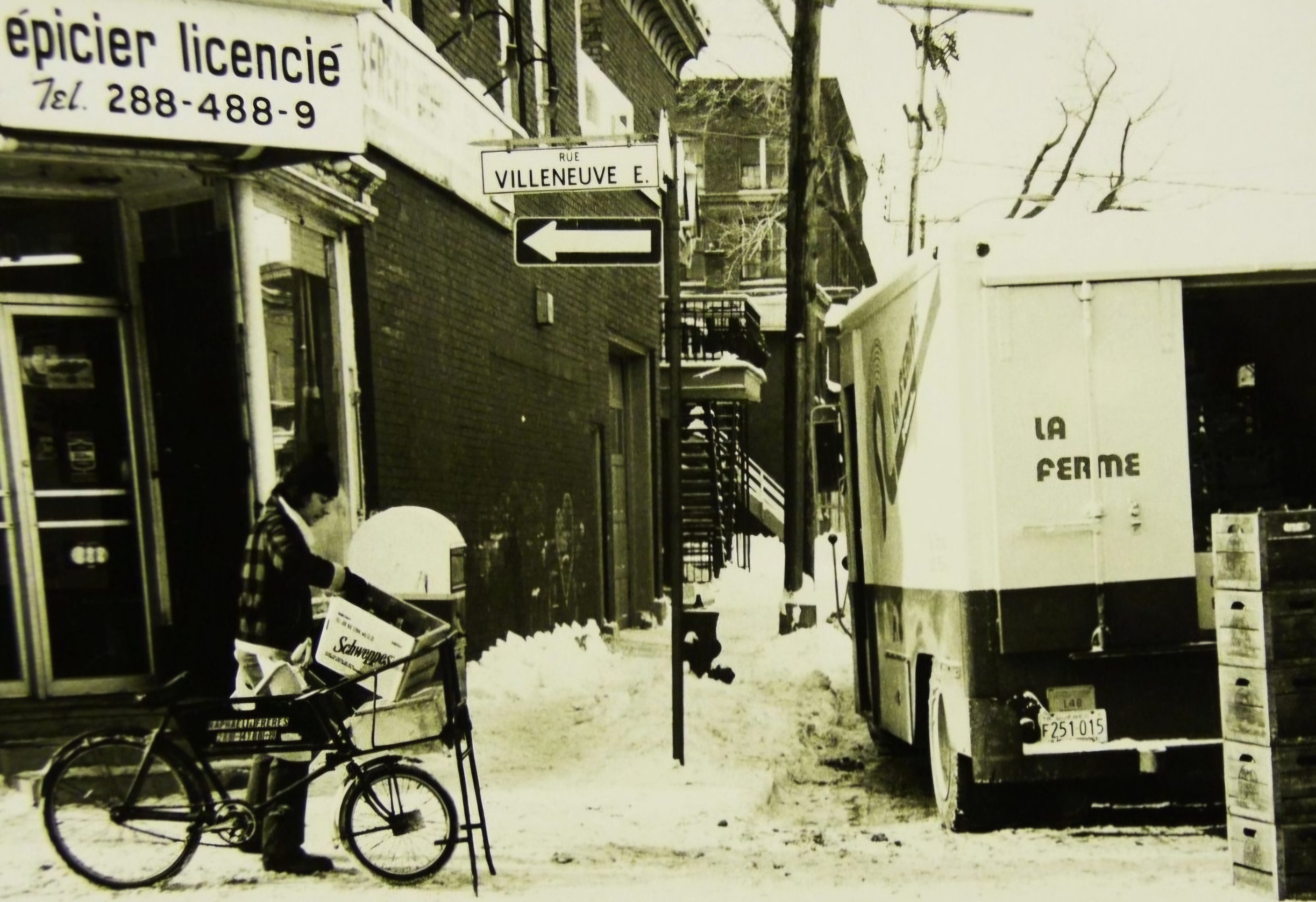
I'm pretty sure that the perfect summer job for a 13 year old aspiring alcoholic is unique to Montreal. Before the advent of convenience stores and big grocery chains, the neighborhood grocery store was a fixture throughout Montreal.
These small stores even sold ice-cold beer delivered to your door by a kid riding a heavy one-speed bike with a big basket sitting over a 20” front wheel. That basket could hold two cases of 24 stubby brown bottles of beer and a small paper bag of groceries.
I grew up in NDG, just west of downtown Montreal and there were two such stores across from each other on the main drag - Sam’s and Blakely’s. If you were just breaking into the game, Sam's is where you started.
It was a hard job. The bike weighed a ton even without a load and handled like crap. The streets in my immediate neighborhood were lined with mostly 4-storey apartment buildings without elevators. Worst case, you'd be humping two cases up four flights of stairs after a long trip standing on the pedals. And you'd likely bring at least an equal number of empties back down the stairs.
I lived in one of those buildings. A small lobby with a stainless steel panel that held mailboxes with doorbells and handwritten tenant names that were occasionally accurate and frequently illegible.
Ring the bell with the edge of a beer case and head to the lobby door while yelling “Sam’s!” and hope that you made it in time to grab the door handle with your index finger and swing it open enough to jam your foot in between the bottom of the door and the jamb before the entry buzzer stopped.
Montreal was very cosmopolitan even in the 60s, so every floor had its own unique smell and sounds. Ditto for the occupants, who could open the door in their underwear or in a suit and tie. Each apartment's character would leak out into the hall as the door opened. One thing was peculiar - in my 3 years, I never once delivered to anyone under 25 or to an ongoing party.
We worked for 75¢ per hour plus tips.
Some of the streets were dangerous. Walkley north of Somerled held a high risk of theft or just a beating for fun.
But it was a cool job. The tips were generous, and if you were coming back with empties, you could jump into one of the many public pools to cool off on your way back to the store. I was mobile, it was the summer of ‘68, and I lived for the cheap, big name concerts every weekend at Place Des Nations, on the site of the 1967 Worlds Fair.
Being a beer boy in Montreal shaped my adult life.
Business at Sam's was never that hectic, so I always had a little time coming back from deliveries to be social. I learned the value of connections and networking. I knew who had drugs and who wanted drugs. I knew who was who. And that ability gave me value - enough value that the guys North of Somerled never once tried to rip me off. These guys would flick your packet of smokes out of your shirt pocket, snatch the pack out of the air, smile and ask “are they fresh?“.
I switched to menthol. Problem solved.
And I learned compassion. Sam and his wife had tattoos on their wrists that told a story of immense suffering. They were Jews and they'd survived Hell. The sadness that seeped from their very beings could at times, be almost too much. And Sam had at some point, suffered a stroke. I didn't understand all of this the way I do now, but I knew that they were fragile and barely keeping it together. Most guys left for busier stores and better tips, but I stayed.
They appreciated it and when Saturday evening closing came around, Sam would always hand me a paper bag and send me into the walk-in cooler to get 6 IPAs. I'd put it on the counter by the cash register and he'd thank me for the week, hand me my pay envelope and gesture at the bag of beer. It was for me.
If the tips had been good, I'd upgrade to a case of 12, hoist it up onto my shoulder and walk down the main street to the park to meet my friends before heading out to the night's adventure.
I came face to face with my first alcoholic through that job. One of my regulars lived a couple of buildings down from me. He was an Olympic athlete according to local lore and had the photos to prove it. But I delivered two cases of 24 and six packs of smokes to him every two days. His apartment was always dark and smelled of nicotine, stale beer and decay. He looked like he was only one day away from death. And then one day, the deliveries abruptly stopped.
I worked at Sam's for three years - every summer and a bit of brutal part time work in the winter. Saving for the motorcycle my parents weren't going to allow me to buy.
My parents had separated a few years prior and only recently reconciled. The home dynamic was stressed before the separation, even more so during, and now back to what we called normal. I coped by living in another world inside my head.
My network grew, my drinking progressed, and somehow I missed my high school graduation. I simply stopped going to school. At the end of the school year, my parents and my younger sister moved to Chicago.
I stayed. By then, I was no longer present in my life.
I pumped gas at the local Shell station, rode my motorcycle and stayed buzzed. A year went by that I'm barely able to remember. But in August, my father called me and asked me if I wanted to go to Chicago and attend college. I agreed, though I can't say why. Or why not. That's the state I was in.
A month later, he showed up with a trailer, loaded up my bike and we drove down to Chicago. Straight through, 14 hours door to door.
And something changed. I could feel it, but I couldn't name it.
He'd managed to get me into a community college, enrolled in a Computer Science program. I moved into the basement of their townhouse in Des Plaines, a northern Chicago suburb, and the college was 20 minutes away by car. He gave me a high mileage ‘66 Biscayne to use when the weather got too rough for the bike.
From downtown Montreal to suburban Chicago. No buses, no apartment buildings. No neighborhood. No tribe.
I can see now that Chicago was an opportunity that I missed. I was off-balance, in a new environment without my tribe and nothing was familiar. I couldn't drink the way I was used to now that I was living at home, and I was about to start college in a new country. I had a freedom at home that I'd never had in Montreal. I could start fresh.
And I did. For a couple of semesters, anyway.
College was amazing. It had only been operating for a few years and was housed in a cluster of six older warehouses. The biggest shock was how much more mature the students were than the tribe I'd left in Montreal. And how much of the early seventies culture I'd missed while stumbling around NDG in a fog.
I had to grow up incredibly fast and I stepped up to the plate. It was like drinking from a fire hose. On top of the culture shock, an instant requirement to learn what I was being taught. I was learning how to program computers and had no idea what that really meant.
And then I met Evelyn.
She sat beside me at the large circular cafeteria table where I was devouring my burger and onion rings. She ate a tomato like it was an apple. I gawked. Then she started on a pomegranate. I'd never seen one and I'd never been this close to such a striking, confident and natural young woman. I asked about the pomegranate and she asked where I was from. We skipped our classes and hung out for the afternoon.
And something shifted agai>n. This time, it was something dark and dangerous. It was subtle, but I felt it.
Thanks for reading! I …One more thing - Please like and or share this essay so that others can find it.
I don’t put my writing behind a paywall because I want it accessible to anyone who needs it. If you’d like to support the work, please -
consider a paid subscription
or you if you prefer,
Buy Me A Coffee.

Your contributions allow me to sustain and expand Seventy while making it freely available to those who need it.
Work with me 1:1
As we become more comfortable with our new sober lives, we begin to expand by taking on new challenges and experiences with real purpose. The more we embrace personal and professional challenges, the more complex life becomes.
I call that the Expansion Paradox.
We discover that the tools that got us sober aren’t designed to support aggressive sober life expansion. We need something that will survive pressure - something that will fire before we have time to negotiate with ourselves. Something that would work on an ordinary Tuesday - and on the day everything went sideways. If you’re experiencing the Expansion Paradox, perhaps I can help. Please visit this page for more details.
Or send me a message on Substack -
and we can set up a video call to figure out if the Seventy Framework’s a fit.
Seventy exists for people who have rebuilt their lives and discovered that success creates its own form of pressure.
If your map no longer matches your territory, you’re not broken. You may just be ready for something steadier